



For most grassroots and semi-professional football clubs, managing money is not the hard part. The hard part is managing everything around it. Knowing who has paid, who hasn’t, what is overdue, what was agreed informally, and what still needs chasing often falls to volunteers who already give up evenings and weekends to keep the club running.
A football club payment system exists to bring order to that chaos. Not by making clubs more professional, but by giving volunteers a clearer, fairer, and more sustainable way to collect and manage fees. This article explains what a football club payment system is, the common payment challenges clubs face, and what to look for when choosing a solution that actually fits how clubs operate day to day.

What Is a Football Club Payment System?
At its simplest, a football club payment system is a structured way for a club to request, collect, and track payments in one place. It replaces the informal mix of cash, bank transfers, spreadsheets, and messages with a more consistent approach that shows clearly who has paid and who has not.
Many clubs describe what they need as a club fee system. That wording is important as the issue is rarely just taking payments. The real challenge is everything that comes after like tracking fees across teams, managing instalments, dealing with missed payments, and answering the same questions week after week.
A modern football club payment system will support online club payments, allowing families and players to pay digitally while giving admins visibility without constant checking or manual updates. This is why clubs increasingly look towards payment software for sports clubs rather than generic payment tools that were never designed for volunteer-run organisations.
How Football Clubs Traditionally Manage Payments
Most clubs begin with methods that are familiar and easy to set up. Membership fees might be paid by bank transfer, match fees collected in cash, and subscriptions tracked informally. A spreadsheet often becomes the unofficial “source of truth”, usually maintained by one person who understands how it works.
This approach isn’t wrong. In fact, it works reasonably well when:
- The club is small
- There is only one or two fee types
- One volunteer handles all admin consistently
Problems emerge as soon as the club grows, changes, or the volunteer moves on. New teams are added, fees increase, instalments are introduced to help families, and suddenly the original system no longer scales. What was once manageable becomes fragmented, and payment admin starts consuming more time than anyone ever expected.

Why Payment Administration Is a Growing Burden for Volunteers
The burden of payment administration rarely shows up all at once. It builds gradually as the number of teams and players within the club increases.
Volunteers then find themselves:
- Checking bank statements multiple times per week
- Matching unclear payment references to names
- Updating spreadsheets late at night
- Sending reminders they feel uncomfortable sending
- Answering “have we paid?” messages repeatedly
- Fixing mistakes caused by partial or duplicate payments
The problem is not that volunteers are unwilling to do this work, it’s that the work never ends and there’s no clear system holding it together. When payment tracking depends on memory, goodwill, or one individual, it becomes fragile. If that person steps away, the club quickly realises how much knowledge was being held together informally.
A football club payment system reduces this reliance on individuals by making payment status visible and consistent, regardless of who is currently volunteering.
The Most Common Payment Challenges Football Clubs Face
While every club is different, the payment challenges they face are remarkably similar.
- Monthly fees
- Subscriptions
- Instalment Plans
- Missed Payments
- Admin Time
Membership fees are often the first pain point. Payments arrive at different times, in different amounts, and sometimes without clear references. Club admins spend time working out who is fully paid and who still owes money.
Subscriptions introduce ongoing complexity. Monthly payments can make football more affordable for families, but they also require regular tracking. Missed months often go unnoticed until they become a larger issue.
Instalment plans are increasingly common for higher-cost programmes but without structure each instalment becomes a bespoke agreement that must be remembered and tracked manually.
Missed payments are perhaps the most difficult issue. Volunteers are reluctant to chase, particularly when they see families regularly at training or matches. What begins as a delayed payment can quietly turn into a significant shortfall for the club.
Finally, admin time is the hidden cost behind all of this. Even when money eventually arrives, the effort required to track, reconcile, and confirm payments places a constant load on volunteers.
What a Modern Football Club Payment System Changes
A modern football club payment system does not eliminate the need for administration, but it changes the nature of the work.
Instead of spending time chasing and cross-checking, volunteers can focus on oversight. Payment status becomes something that can be checked quickly rather than pieced together from multiple sources. Fees are set once and applied consistently, and families know what is due and when thanks to notifications in advance.
Crucially, online club payments remove friction for parents and players. Paying becomes straightforward as confirmations are clear and misunderstandings are reduced. For clubs, this shift often results in fewer missed payments and fewer awkward conversations.
This is where purpose-built payment software for sports clubs becomes relevant. Unlike generic tools, these systems are designed around how clubs actually charge fees, manage teams, and operate seasonally.
Handling Membership Fees More Effectively
Membership fees are one of the clearest areas where a structured system makes a difference.
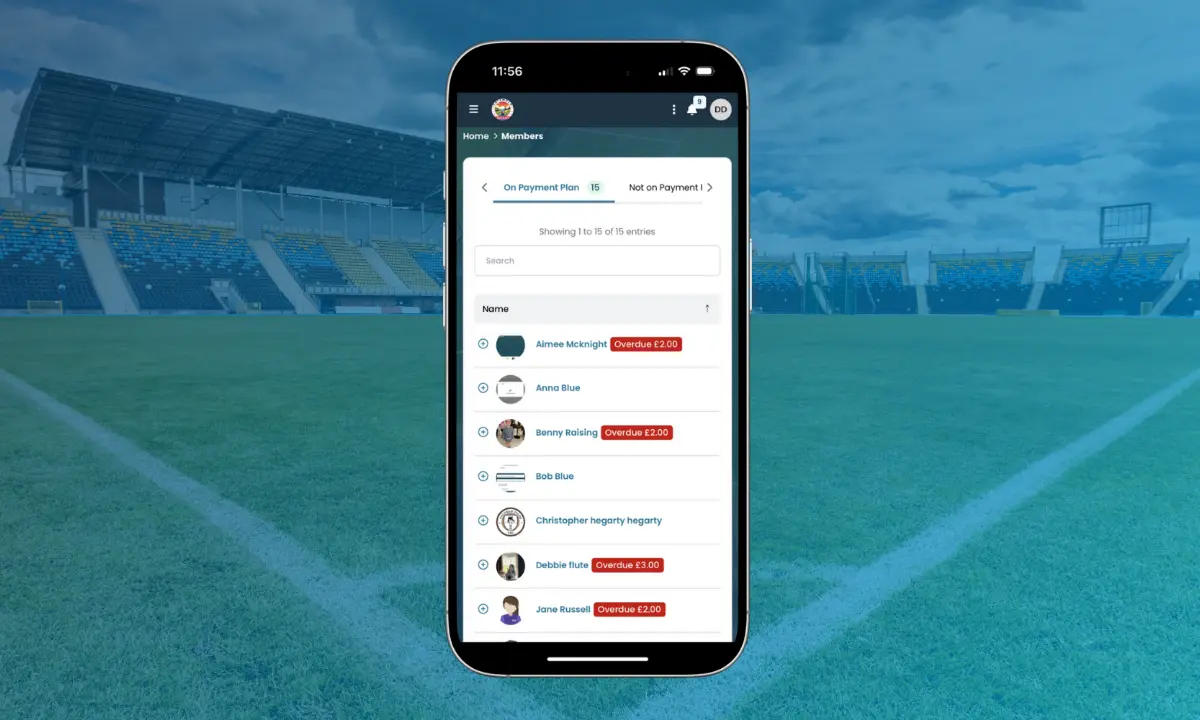
With a football club payment system, clubs can define membership fees clearly, apply them to specific teams or age groups, and see payment status at a glance. Families benefit from knowing exactly what the fee covers and receive confirmation once payment is made.
From an admin perspective, the key improvement is clarity. Instead of relying on memory or spreadsheets, the club can see:
- Which members are paid
- Which are unpaid
- Which are part-paid or overdue
This is why many clubs move towards a dedicated club fee system, like TeamFeePay, once membership numbers increase. The complexity exists whether it is managed or not as the system simply makes it visible and manageable.
Managing Subscriptions and Instalment Plans
Subscriptions and instalments require consistency over time. Without structure, they quickly become difficult to manage.
A football club payment system allows subscriptions to be set up once and monitored automatically. If a payment is missed, it is visible early before it becomes a larger issue. Instalment plans can be structured clearly so both the club and the family or player understand what is outstanding.
This consistency reduces the exceptions that often overwhelm volunteers, rather than remembering individual arrangements the system holds the agreement.
Platforms such as TeamFeePay are designed to support these scenarios because they reflect real club behaviour with annual fees for some teams, monthly subs for others, and instalments where affordability matters.
Reducing Missed Payments Without Constant Chasing
One of the biggest benefits of a football club payment system is how it changes the dynamic around missed payments.
Instead of relying on personal messages from volunteers, reminders can be handled as part of a standard process. Payment status is visible, deadlines are clear, and follow-up feels procedural rather than personal.
This matters because many missed payments are not intentional. They are the result of confusion, forgetfulness, or unclear expectations. A structured system reduces ambiguity and allows issues to be addressed earlier and more calmly.
Saving Admin Time and Protecting Volunteers
Time savings are often the first benefit clubs notice after adopting a football club payment system.
Admin time is reduced because:
- Payments are tracked automatically
- Reconciliation is simpler
- Payment history is centralised
- Fewer clarification messages are needed
This is why clubs often search specifically for payment software for sports clubs rather than adapting general accounting or payment tools. The value is not just in taking payments, but in reducing the background work that drains volunteer energy.

Key Features to Look for in a Football Club Payment System
When evaluating options, clubs should focus less on feature volume and more on practical fit.
A suitable football club payment system should:
- Support one-off fees, subscriptions, and instalments
- Provide clear visibility of payment status
- Be simple enough for volunteers to use confidently
- Offer a straightforward experience for parents and players
- Produce clear reports for treasurers and committees
Complexity rarely helps grassroots clubs. The most effective systems are those that quietly support existing workflows rather than forcing clubs to change how they operate.
Choosing the Right System for Your Club
The right football club payment system is one that matches the reality of the club.
Clubs should consider:
- How many different fees they collect
- How often payments are missed or delayed
- Where admin time is currently being spent
- How comfortable volunteers are with new tools
For clubs that want a football-specific solution rather than adapting generic software, TeamFeePay is one option designed around these needs. It acts as a club fee system that supports online club payments while keeping admin manageable for volunteers. The platform also includes a wide range of other features to help with club management and club development.
Final Thoughts
A football club payment system is not about technology for its own sake. It is about making sure the club’s finances are clear, fair, and sustainable without relying on constant manual effort.
For grassroots and semi-professional clubs the goals are simple, have fewer missed payments, less admin pressure, and more time spent on football. A structured system helps achieve that, not by changing what clubs are but by supporting how they already work.
Discover if TeamFeePay is a good fit for your club by requesting more information today.